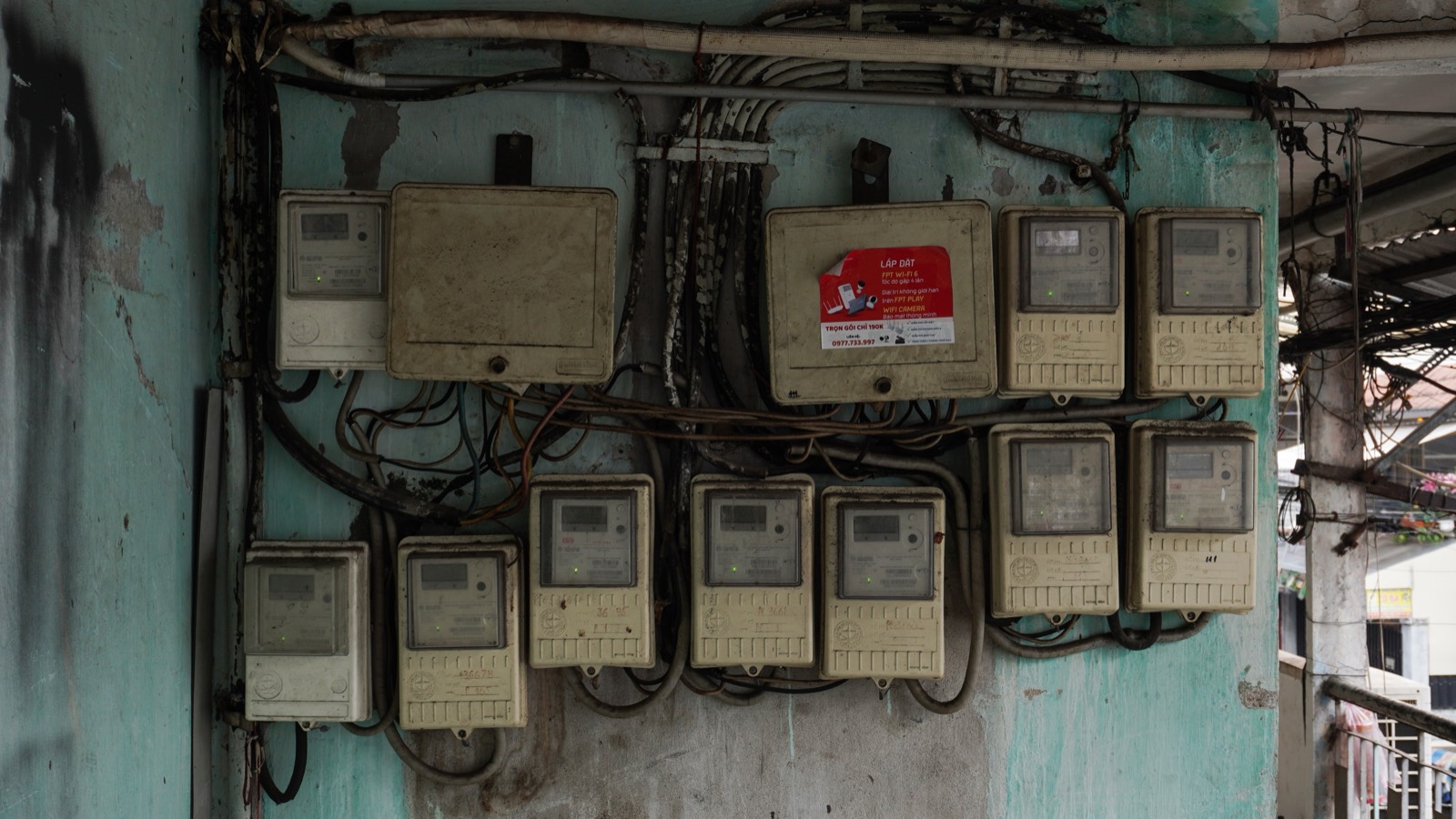
The bill that never appears in the advert
We parse a set of fields out of every listing, including electricity price, water price, whether internet is included and whether the management fee is included. On the 2,465 listings live in August 2026, all four are empty. Not rare — empty.
So the recurring cost of actually living in the flat, which over a year can rival a month of rent, is simply not part of what the market advertises. The advert tells you the one number that is easy to compare and silent on the numbers that decide whether it was a good deal.
That is what makes two apartments at the same rent genuinely different. One includes Wi-Fi and cleaning but bills water, power and building management separately; in another the owner reads an internal sub-meter and sends you a single figure. Once the air conditioning runs every day through a Saigon summer, the gap between them stops being a rounding error.
Three questions settle it, and all three can be asked in one message before you travel: which services are included in the rent, who issues each bill, and how measured consumption becomes the amount you hand over. "It's the government rate" is not an answer to the third one without a document behind it. You can compare the asking rents themselves on our live medians, but no median can tell you what the meter will do.
What the official price actually is
Vietnam's residential electricity tariff is public. Under the retail schedule in Decision 1279/QĐ-BCT, household consumption is charged in six steps, from ₫1,984 per kWh for the first 50 kWh up to ₫3,460 per kWh above 400. The published schedule does not spell out its VAT treatment, so when you compare it against a real bill, ask whether the figure in front of you includes tax.
The tiers matter more than any single number. Because the price climbs with volume, quoting the cheapest first-step figure describes a very small bill and nothing else. A household running air conditioning lands in the upper steps, and that is the part of the schedule worth looking at.
There is also a rule written for exactly our situation. For rented accommodation on a lease shorter than twelve months, where the owner cannot document who is living there, the whole meter is billed at the third step — ₫2,380 per kWh. When the owner does register the residents, the tiers apply to their allocated share instead. Note what that rule is: a method the supplier uses to price a meter it cannot attribute. It is not permission for an owner to invent a service rate.
What a landlord may lawfully collect
This changed recently and in the tenant's favour. The Vietnamese government's own explanation states that a landlord must not collect more from tenants than the electricity seller billed for that consumption, and that charging above the regulated residential price can draw a fine of ₫20–30 million. The instrument is Decree 133/2026/NĐ-CP, issued on 6 April 2026.
That does not turn every bill into one line of arithmetic. VAT, common areas, a genuinely separate building service, or several units sharing one meter can all complicate it. The test is whether each part is named. A real extra service has a name and a number; an unexplained markup hides inside the per-kilowatt price where nobody can see it.
And it does not make an internal sub-meter suspicious in itself. Plenty of buildings work that way, perfectly honestly. It just means the arithmetic should be showable on request — and now there is a reason for the landlord to keep it showable.
What renters actually report
The pattern in expat accounts is consistent across a decade: utilities are separate, and the way they are charged varies by building rather than by law.
In October 2013, IceWater listed what comes on top of a long lease: «Интернет … всегда оплачивается отдельно при долгосрочной аренде (как и электричество, вода, газ и телефон, если он есть)». Earlier, in November 2012, Pinky Yazz described a Vũng Tàu building charging ₫350,000 for security, common-area cleaning and lifts, with electricity billed separately on top — a useful reminder that building management and energy are different lines that sometimes get quoted as one.
The most-cited example of a flat landlord rate comes from Шницель in February 2017, describing a Nha Trang flat: «И электричество по 4 тыщи». Read it carefully, because we did: the post does not spell out the unit. In a rental context it can only sensibly mean ₫4,000 per kWh, and on that reading it sits above the top step of the regulated household schedule — which is exactly why this kind of quote is worth asking about rather than accepting. But it is one tenancy, in 2017, and neither a legal precedent nor a 2026 benchmark.
Which brings the honest caveat for this whole section: these posts are from 2012 to 2017. They are good evidence of how bills are structured and bad evidence of what anything costs today. Do not carry a 2013 figure into a 2026 budget.
Checking the number before you sign
Ask for the last supplier invoice, or a photo of the electronic bill with other people's details cropped out. Check the service address or meter reference, the billing period, the kWh volume and the total. Then establish whether the apartment has its own supplier meter or whether the owner reads an internal one — that single fact changes what you can verify later.
Photograph the meter reading together on handover day, and again on the same date each month. The reconciliation is not complicated: this month's reading minus last month's is your consumption. Compare that against the supplier's bill and the method written in the contract, rather than against a number that arrives by message. Keep proof of every payment.
The lease should list electricity, water, management, parking, internet and cleaning as separate lines. "Utilities paid by tenant" is not a term, it is a blank cheque. If the owner collects for electricity, write down that the amount is backed by meter readings and a copy of the supplier's calculation.
Ask how shared consumption is handled. Corridor lighting, lifts and pool pumps usually belong in the management fee, not on your private meter — and you should not pay for the same corridor twice under two different names. The full handover sequence is in our move-in checklist, and the money conversation this belongs to is covered in the deposit guide.
Water has no single national figure
We looked, and we are not going to invent one. Water pricing depends on the city, the supplier, the category of building and whether there is an individual meter at all. Some places charge per cubic metre, some a fixed amount per occupant, some fold it into a service fee.
So ask for the unit of calculation and the previous bill, photograph the water meter if one exists, and clarify whether wastewater or any other service is bundled in. If the charge is fixed and unrelated to consumption, get the amount and the rule for changing it into the contract before the deposit moves.
Opacity before signing is itself a finding. A good apartment does not become good value because an unexplained utility markup was described as how things are done here.
Update: May 2025 electricity price increase
On May 9, 2025, EVN announced a 4.8% increase in the average retail electricity price, effective May 10, 2025. The increase was attributed to soaring generation costs and described as the fourth since early 2023.
What the adjusted average retail price was
Effective 10 May 2025, the adjusted average retail electricity price is VND 2,204.0655 per kWh, excluding VAT, a 4.8% increase over the previous average. Under this adjustment, the available excerpt states that residential daily-life electricity users would pay an additional VND 4,550; the rest of the amount or range is truncated. EVN said the adjustment was calculated to minimize the impact on the economy and people's livelihoods.
According to the cited reports, a prior adjustment on 11 October 2024 raised the average electricity retail price from VND 2,006.79 per kWh, the previous average price in effect before that date, to VND 2,103.1159 per kWh — about 4.8% higher. The 10 May 2025 adjustment was reported to set the average price at VND 2,204.0655 per kWh excluding VAT, also described as about 4.8% higher, with only minimal effect on poor households and families receiving preferential treatment.
How the tariff structure is described
Decision No. 14/2025/QD-TTg, issued by the Prime Minister on 29 May 2025, describes the retail electricity tariff structure as percentages of the average retail electricity price, used to calculate prices for different customer groups. EVN declared the average retail electricity price, excluding VAT, at VND 2,204.0655 per kWh as of 10 May 2025, under Decision No. 599/QD-EVN dated 7 May 2025.
Frequently asked questions
- Is electricity included in rent in Vietnam?
- Usually not on a long lease, and you should never assume. Not one of the 2,465 listings we index states the electricity price, so the only way to know is to ask before you travel and get the answer into the contract.
- What is the official electricity price in 2026?
- The residential schedule under Decision 1279/QĐ-BCT runs in six steps from ₫1,984 per kWh for the first 50 kWh to ₫3,460 above 400 kWh. The published schedule does not state its VAT treatment, so check whether the bill you are shown includes tax.
- Can a landlord charge a flat rate per kWh?
- Internal billing is common and not wrong in itself, but it does not permit collecting more than the supplier charged. Since Decree 133/2026/NĐ-CP, charging above the regulated residential price can draw a ₫20–30 million fine. Ask for the supplier bill, the readings and the formula in writing.
- What happens if the lease is shorter than 12 months?
- If the owner cannot document who lives there, the supplier prices the whole meter at the third step, ₫2,380 per kWh. If the residents are registered, the normal tiers apply to their share. That is how the supplier prices the meter — not a licence for the owner to set any rate.
- How do I check the meter?
- Photograph it at handover and on the same date each month, confirm it actually serves your unit, and reconcile the difference against the invoice. Meter photos are the cheapest insurance in a tenancy.
- What does water cost?
- There is no single national figure, and anyone quoting one is guessing. It varies by city, supplier and building, and may be per cubic metre, per person or inside a service fee. Ask for the last bill and the unit of calculation.
- Did electricity prices increase in Vietnam in May 2025?
- Yes, EVN announced a 4.8% increase in the average retail electricity price, effective May 10, 2025. The increase was attributed to soaring generation costs and described as the fourth since early 2023.
- What is the decision number for the May 2025 electricity price adjustment?
- According to Vietnam Electricity, Decision No. 599/QD-EVN dated 7 May 2025 concerned an adjustment to the average retail electricity price. Vietnam Electricity published a webpage about the decision at 17:57 on 9 May 2025; the page states that details of the decision can be viewed and a file downloaded.
Updated: 2026-09-30